
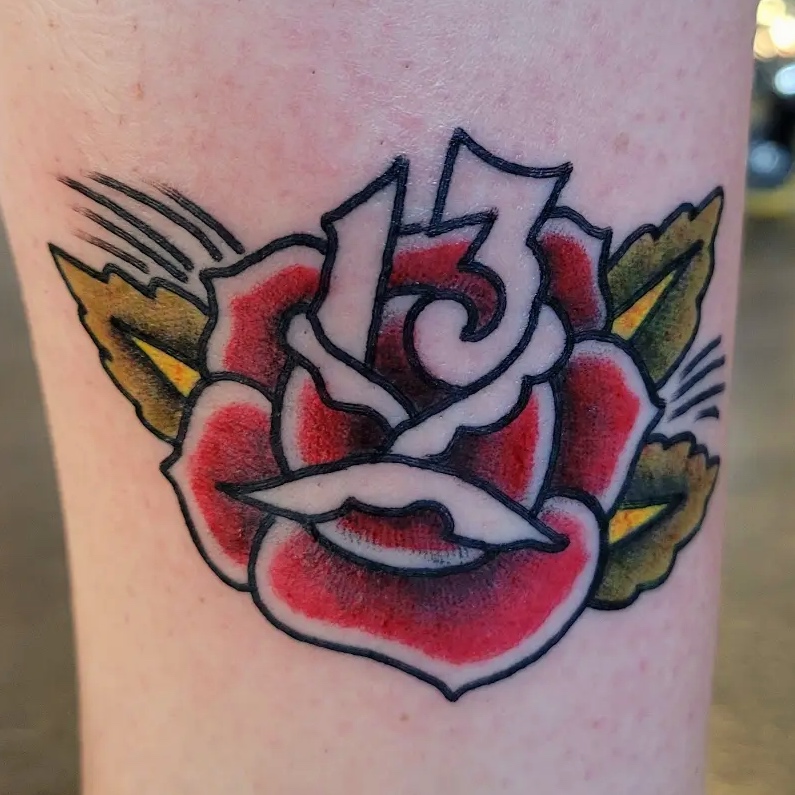
Custom floral tattoos are often misunderstood as “simple pretty designs,” but in professional tattooing they are actually some of the most structurally complex and composition-heavy pieces you can get. In Raleigh, demand for high-end floral work has increased because clients are moving away from generic flash and toward fully custom tattoos that are designed around anatomy, longevity, and meaning.
At studios like Raleigh Tattoo Co., floral tattoos are treated less like decoration and more like architectural design systems applied to living skin. A strong floral tattoo is built through planning, flow mapping, symbolic selection, and technical execution that considers how the tattoo will look not only on day one, but also 5, 10, and 20 years later.
What “Custom” Actually Means in Floral Tattoo Design
A true custom floral tattoo is not just a flower picked from a stencil sheet. It is a design that is built specifically for one body and one visual outcome.
At Raleigh Tattoo Co., “custom” typically means:
- The flower species, arrangement, and scale are selected intentionally
- The composition is drawn specifically for the client’s body shape
- The flow is mapped to muscles, joints, and natural movement
- The tattoo is designed to age and soften in a controlled way
This is important because skin is not a flat surface. It is a moving, stretching, aging biological system. A design that looks balanced on paper can collapse visually if it is not engineered for the body.
Composition: The Most Important Factor in Floral Tattoo Quality
Composition is the difference between a tattoo that looks expensive and one that looks random. In advanced floral work, flowers are not just placed—they are arranged like a visual flow system.
A strong floral composition from Raleigh Tattoo Co. considers:
- focal hierarchy (main flower vs supporting elements)
- directional flow (how the eye moves across the tattoo)
- spacing and negative space (preventing overcrowding)
- anatomical alignment (muscle and bone structure)
- visual rhythm (repetition vs variation in petals, stems, leaves)
For example, a floral sleeve is not just “flowers wrapped around an arm.” Instead, stems and vines act like structural lines that guide movement from shoulder to wrist. Larger blooms are used as focal anchors, while smaller flowers and leaves support transitions between sections.
Without this planning, floral tattoos often become visually chaotic after healing.
Floral Placement and Why It Changes Everything
Placement is one of the most underestimated parts of tattoo quality, especially for floral designs. The same flower design behaves completely differently depending on where it is placed.
Arm and Sleeve Work
On sleeves, floral tattoos must maintain continuous flow. At Raleigh Tattoo Co., sleeves are often designed so that:
- flowers rotate with muscle movement
- stems follow natural curvature of the arm
- petals break up dense areas to create visual breathing room
Poor sleeve design leads to “floating flowers” that don’t connect visually.
Ribcage Tattoos
Rib tattoos are highly technical due to breathing movement and curvature. Floral designs here often:
- stretch vertically or diagonally
- use elongated stems for flow stability
- avoid overly dense shading in high-flex areas
At Raleigh Tattoo Co., rib floral designs are carefully spaced so the tattoo does not distort when the body expands and contracts.
Thigh Tattoos
The thigh allows for large floral compositions with strong focal control. This area often supports:
- full rose clusters or mixed floral arrangements
- bold central blooms with surrounding supporting flowers
- smooth gradient shading for depth and softness
This placement is often chosen for larger storytelling floral pieces.
Back Pieces
Back floral tattoos are among the most complex because they must account for:
- symmetry or intentional asymmetry
- shoulder blade movement
- spinal alignment
- large-scale visual balance
Raleigh Tattoo Co. often uses large floral structures to frame central subjects or create full-body flow across the back.
Symbolism: Why Flower Choice Matters
In custom tattooing, flowers are rarely chosen just for appearance. Each bloom carries symbolic weight that can change the emotional tone of the entire piece.
Common meanings include:
- Rose: emotional complexity, love, duality, sacrifice
- Lotus: transformation, spiritual growth, resilience
- Peony: power, prosperity, honor, controlled strength
- Cherry blossom: impermanence, acceptance of change
- Sunflower: loyalty, direction, emotional stability
- Lily: purity, renewal, remembrance
At Raleigh Tattoo Co., these meanings are often combined to build layered narratives. For example, a rose and cherry blossom combination might represent both love and impermanence, creating a more complex emotional story than either flower alone.
Reference material on symbolism and plant meaning:
https://www.britannica.com/plant/rose-plant
https://www.britannica.com/plant/lotus-plant
https://www.britannica.com/plant/peony
https://www.britannica.com/plant/cherry-tree
Why Floral Tattoos Age the Way They Do
All tattoos change over time due to skin biology. Ink is deposited into the dermis, where it is partially stabilized by immune cells, but it still undergoes slow diffusion and visual softening.
Scientific research shows tattoo pigment remains in dermal tissue long-term and is continuously processed by immune system cells, which contributes to gradual changes in appearance over time.
Sources:
https://pubmed.ncbi.nlm.nih.gov/29657931/
https://www.ncbi.nlm.nih.gov/pmc/articles/PMC5816087/
https://pubmed.ncbi.nlm.nih.gov/36787702/
For floral tattoos, this means:
- fine line details may soften over time
- overcrowded petals can merge visually
- weak contrast fades faster
- poorly spaced designs lose clarity
At Raleigh Tattoo Co., designs are built with these changes in mind by:
- leaving intentional negative space
- avoiding unnecessary micro-detail in high-movement zones
- strengthening contrast between petals and background
- using structure-first composition instead of decoration-first design
What Makes a Floral Tattoo High Quality vs Low Quality
A high-quality floral tattoo from Raleigh Tattoo Co. typically includes:
- strong composition with clear focal points
- intentional flow that follows anatomy
- balanced spacing and negative space
- consistent shading and contrast control
- design that remains readable after healing
A low-quality floral tattoo often shows:
- overcrowded or visually noisy composition
- no clear flow direction
- inconsistent sizing of floral elements
- detail that collapses after healing
- weak structural planning
The difference is not just artistic ability—it is design engineering.
The Design Process at Raleigh Tattoo Co.
A proper custom floral tattoo is built in stages:
- Consultation and concept development
- Placement and anatomy mapping
- Symbolic selection of flowers and meaning
- Composition sketching and flow design
- Refinement for spacing, balance, and readability
- Staged tattoo application for healing and layering
This process ensures that every floral tattoo is not just visually appealing, but structurally sound and built for long-term stability.
Final Thoughts
Custom floral tattoos are far more technical than they appear. While they may look soft or simple on the surface, they require deep understanding of anatomy, composition theory, symbolism, and skin biology.
At Raleigh Tattoo Co., floral tattoos are treated as long-term design systems rather than standalone images. The goal is not just to create something beautiful in the moment, but to build a tattoo that maintains clarity, emotional meaning, and structural integrity for decades.
A great floral tattoo is not just a design choice—it is a carefully engineered balance between art, anatomy, and time.
